
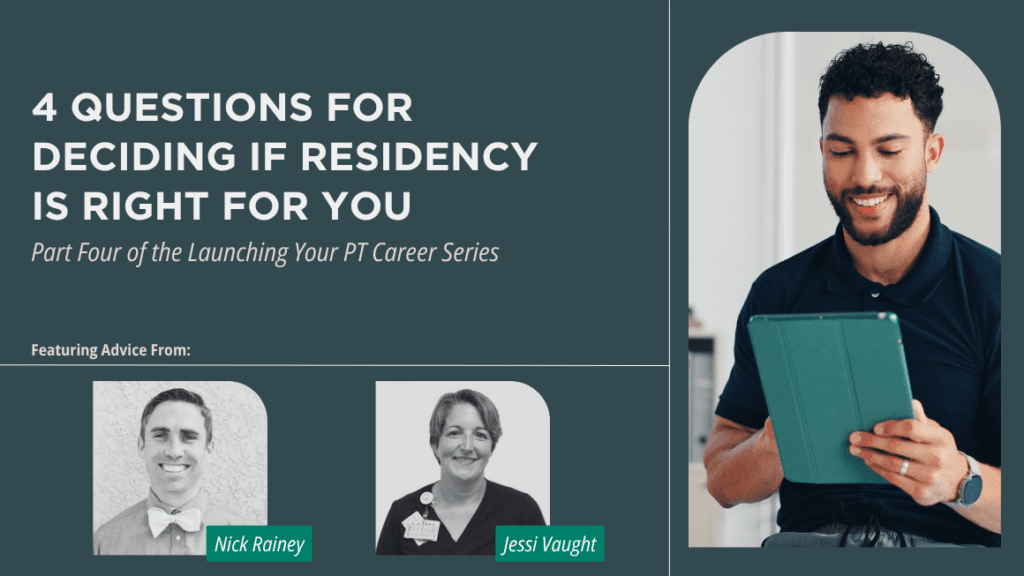
4 Questions for Deciding if PT Residency is Right for You
This is the fourth blog post in Rizing Tide’s new series about launching your PT career and landing the right PT role for you. In our previous posts, we covered how to approach interviews, evaluate job benefits, and choose a specialty. In this installment, we focus on another major early-career decision: deciding if a residency is the right next step for you.
Is a residency program the best way to grow as a new physical therapist—or is it an unnecessary extra step in your career?
Some clinicians see residency as the fastest path to obtaining advanced skills and specialization. Others see residency as an unnecessary educational hurdle, as PTs can sometimes build the same expertise through mentorship, deliberate practice, and continuing education.
The debate is nuanced, and no one is fully right or fully wrong; what worked for your mentor might not work for you and vice versa. Understanding when a residency makes sense—and when it doesn’t—can help you make one of the first major decisions of your career.
To help you navigate this decision, we once again spoke with Dr. Nick Rainey, PT, DPT, OCS, FAAOMPT, owner of Rainey Pain & Performance, and Dr. Jessi Vaught, PT, DPT, NCS, physical therapy advisor at Sheltering Arms Institute, both of whom work closely with early-career clinicians and residency-trained PTs.
Read on to learn the four questions you should ask yourself when thinking about PT residency, and soak up some advice from pros who work with new grads just like you.
1. Do you prefer structured learning or to learn as you go?
Do you prefer to follow a planned program curriculum—or would you rather gain experience on the fly? After graduation, you get to make that decision, and while both paths can help you grow, they look very different on the day to day.
Residency programs offer structured mentorship, focused practice, and a deep dive into a specific care setting. Vaught works closely with a neurologic residency in partnership with Virginia Commonwealth University, and has seen firsthand how that structure shapes early-career clinicians.
“We partner with VCU, and we do have a neuro residency program,” she says. “In our inpatient hospital, neuro residents rotate between our three neuro units: stroke, brain injury, and spinal cord injury. They also rotate through an SAI outpatient clinic, a VCU outpatient clinic, and VCU acute care. Through the residency, we are able to use some of their nonclinical time for exposure to other relevant areas.”
From her perspective, residency makes the most sense when clinicians are looking to deepen their reasoning skills and explore the continuum of care.
“If you are really looking to advance your problem-solving skills and clinical reasoning, a residency is a great opportunity,” she says. “It is also a great way to figure out where in that continuum you want to be, whether that’s acute care, inpatient rehab, or outpatient.”
At the same time, she cautions that residencies are not the end-all be-all, saying: “I do not think they are necessary for everyone. If you work somewhere with a strong mentorship program or a really great culture of learning and education, that can also support growth.”
2. What do you want out of your residency?
Not all residency programs are built the same, and the structure of a program can significantly impact your time, finances, and career flexibility. Before you commit to one, take a closer look at what you are signing up for.
Reading Residency Contracts
Rainey encourages new grads to examine the details of a residency before committing.
“When you choose a residency, you have to know what the contract really says,” he cautions. “Are there ramifications if you get out early? Some places pay a lot more, some a lot less; some have longer contracts, some shorter. When I was a new grad, my residency commitment was actually seven years. I thought it was five, but it was actually five from the time after you got your specialty, which takes a couple of years. It was a lot more expensive to buy out if we wanted to get out. Be judicious when you choose.”
Picking Mentors
Rainey also emphasizes the importance of mentor fit. “With residency, the only requirement as a mentor is that they have their specialty. You want to know if your personalities work well together. Do you value their background? Some mentors are going to align with you more than others. Maybe spend a few hours in the clinic asking for their ideas and making sure it is going to be a good fit.”
Staying With an Employer
From Vaught’s perspective, residency can also serve as a pathway to employment and a fast track toward career advancement.
“Our neuro residency is one year. Some residents decide to stay on with either SAI or VCU afterward as a full-time employee, and some do not,” Vaught says. But she adds that those who stay and who’ve done well in residency see an advantage when climbing the career ladder. “They do not necessarily come in at a higher formal position, but they can more quickly participate in our clinical ladder activities, and they have already had experiences to apply to that.”
3. What will help you improve as a clinician?
Whether you choose to attend a residency or go straight into generalized practice, your growth will depend on your environment. Clinics can still provide strong mentorship, feedback, and access to education without residency.
Reviewing Game Tapes
At Rainey Pain & Performance, Nick Rainey and his team create deliberate opportunities to self-reflect and practice with patients. “We record videos of first and second visits, and then we critique them as a clinic.” Rainey explains. “We tell each other what we did well and what we did wrong. Until you see exactly where you messed up with a specific patient, it is pretty difficult to improve. Deliberate practice should not be limited to when you are an entry-level student or a resident. You need deliberate practice throughout your career.”
Proactively Seeking Knowledge
Rainey also recommends proactive over reactive learning. He says, “You want information pushed to you. If you have to go out and seek a journal article every time you have a question, that is tough. Sometimes we need to do that, but you need information coming to your inbox or getting mailed to you so you can learn with less seeking time. If you are waiting until you have free time, it is not going to happen.”
Matching with a Mentor
The Sheltering Arms Institute takes a differently structured approach to mentoring and education, describes Vaught.
“We have formal mentoring for all of our full-time employees,” she says. “They are set up with one to two mentors, either within their clinic or in the same specialty. It is a one-year formal mentoring where they set aside time and work through some modules. Initially, it is weekly for an hour or two, and then it moves out to monthly by the end of the year. That time is already built into their schedule.”
Attending CEUs and Testing Settings
Vaught’s organization also offers multiple continuing education options, she adds. “We bring in at least one in-person course a year, and we make a lot of online learning available to the staff. We have a new Core Academy, and therapists can get free continuing education units for that. There are also benefits if somebody wants to take an external course. As an organization, there are a lot of good opportunities at hand when someone identifies an area of interest or a hole in their knowledge base.”
4. Are you committed to excellence?
Despite their different approaches to nurturing new grads, both Rainey and Vaught struck on a single theme: your long-term success depends on your commitment to learning and becoming excellent at what you do.
“As Steve Martin said, ‘Be so good they cannot ignore you,’” Rainey advises. “If you only look at the financial payoff for being good, you will always be a little bit frustrated. Just focus on doing a good job with patients. There are other factors in a quality career, but you will never be disappointed by being the best you can be.”
Vaught also reminds new grads to stay grounded in patient care. She says, “We learn the most from our patients. We have the book knowledge, and that is important, but it comes down to the patient and what they are telling you. Are they satisfied with the treatment? Are they working really hard? Are they excited about what the future may hold? If you can get your patients excited and you can be excited for them, you have probably found your spot.”
As you weigh your options and decide if residency is right for you, remember that there is no single path to building your perfect career. What matters most is finding strong mentorship, continuing to learn, and choosing an environment that supports your growth as a clinician.
Rizing Tide will continue to support you with resources, scholarships, and stories from clinicians who have navigated these decisions, so you can confidently build the PT career of your dreams.
